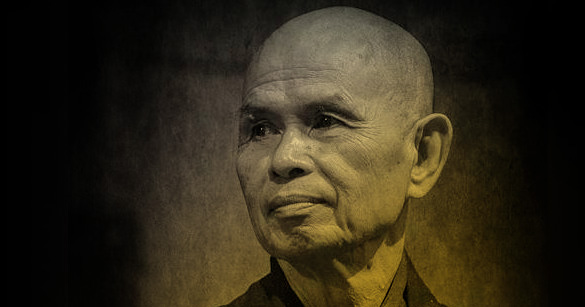
What does love mean, exactly? We have applied to it our finest definitions; we have examined its psychology and outlined it in philosophical frameworks; we have even devised a mathematical formula for attaining it. And yet anyone who has ever taken this wholehearted leap of faith knows that love remains a mystery — perhaps the mystery of the human experience. Learning to meet this mystery with the full realness of our being — to show up for it with absolute clarity of intention — is the dance of life. That’s what legendary Vietnamese Zen Buddhist monk, teacher, and peace activist Thich Nhat Hanh (October 11, 1926–January 22, 2022) explores in How to Love (public library) — a slim, simply worded collection of his immeasurably wise insights on the most complex and most rewarding human potentiality. Indeed, in accordance with the general praxis of Buddhist teachings, Nhat Hanh delivers distilled infusions of clarity, using elementary language and metaphor to address the most elemental concerns of the soul. To receive his teachings one must make an active commitment not to succumb to the Western pathology of cynicism, our flawed self-protection mechanism that readily dismisses anything sincere and true as simplistic or naïve — even if, or precisely because, we know that all real truth and sincerity are simple by virtue of being true and sincere. Thich Nhat Hanh At the heart of Nhat Hanh’s teachings is the idea that “understanding is love’s other name” — that to love another means to fully understand his or her suffering. (“Suffering” sounds rather dramatic, but in Buddhism it refers to any source of profound dissatisfaction — be it physical or psychoemotional or spiritual.) Understanding, after all, is what everybody needs — but even if we grasp this on a theoretical level, we habitually get too caught in the smallness of our fixations to be able to offer such expansive understanding. He illustrates this mismatch of scales with an apt metaphor: If you pour a handful of salt into a cup of water, the water becomes undrinkable. But if you pour the salt into a river, people can continue to draw the water to cook, wash, and drink. The river is immense, and it has the capacity to receive, embrace, and transform. When our hearts are small, our understanding and compassion are limited, and we suffer. We can’t accept or tolerate others and their shortcomings, and we demand that they change. But when our hearts expand, these same things don’t make us suffer anymore. We have a lot of understanding and compassion and can embrace others. We accept others as they are, and then they have a chance to transform. Illustration from Hug Me by Simona Ciraolo The question then becomes how to grow our own hearts, which begins with a commitment to understand and bear witness to our own suffering: When we feed and support our own happiness, we are nourishing our ability to love. That’s why to love means to learn the art of nourishing our happiness. Understanding someone’s suffering is the best gift you can give another person. Understanding is love’s other name. If you don’t understand, you can’t love. And yet because love is a learned “dynamic interaction,” we form our patterns of understanding — and misunderstanding — early in life, by osmosis and imitation rather than conscious creation. Echoing what Western developmental psychology knows about the role of “positivity resonance” in learning love, Nhat Hanh writes: If our parents didn’t love and understand each other, how are we to know what love looks like? … The most precious inheritance that parents can give their children is their own happiness. Our parents may be able to leave us money, houses, and land, but they may not be happy people. If we have happy parents, we have received the richest inheritance of all. Illustration by Maurice Sendak from Open House for Butterflies by Ruth Krauss Nhat Hanh points out the crucial difference between infatuation, which replaces any real understanding of the ot
The Marginalian · 双语精读
How to Love: Legendary Zen Buddhist Teacher Thich Nhat Hanh on Mastering the Art of “Interbeing”
2026.07.17 · art