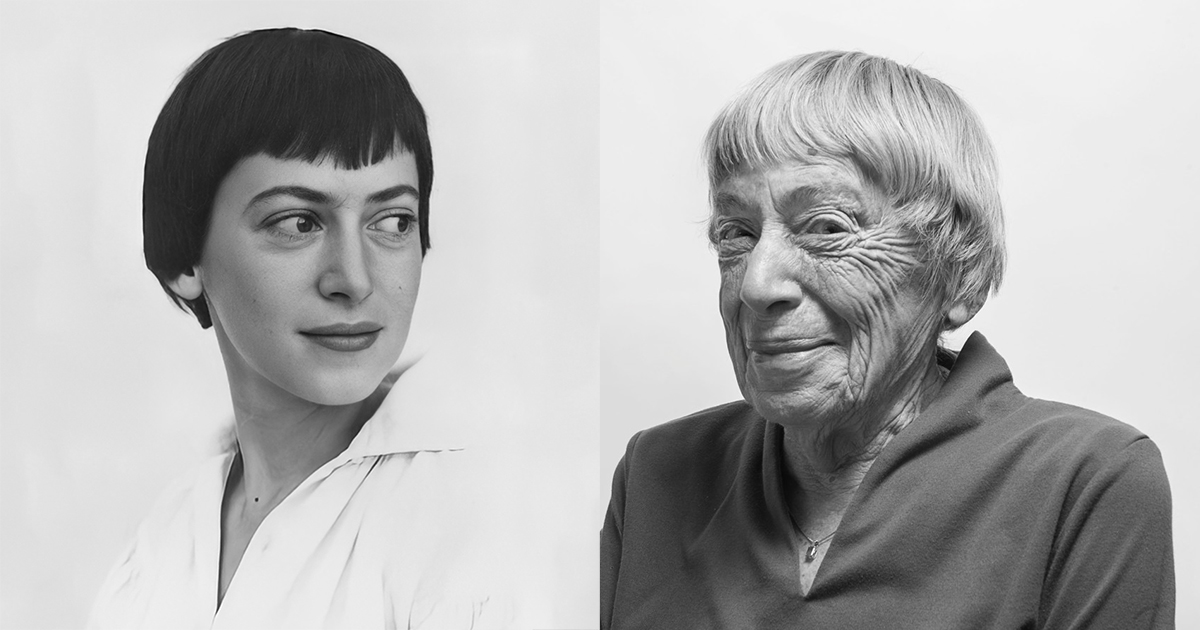
A great paradox of being alive in this civilization is that we have come to dread and devalue the triumph of having lived, forgetting that to grow old is not a punishment but a privilege — that of having survived the loneliness of childhood, the brash insecurity of youth, the turmoil of middle age, in order to begin the continuous creative act of holding on while letting go. This is not easy in a culture that fetishes youth, that clothes us in an invisibility cloak as life strips us of time. We could use all the help we can get — a psychological equivalent of what Eva Perón set out to do politically with her constitutional decalogue for the dignity of growing old. Here is the best help I have encountered over the years — a kind of decalogue for the constitution of the inner country. JANE ELLEN HARRISON The first thing one must do in this culture is refute the romanticizing of youth, recalibrate the value metrics of the self, and no one has done it more concisely and creatively than Jane Ellen Harrison (September 9, 1850–April 15, 1928) — one of the most daring and underappreciated intellects of the past century — in her altogether superb disquisition on youth and old age: People ask: “Would you or would you not like to be young again?” Of course, it is really one of those foolish questions that never should be asked, because they are impossible. You cannot be — you that are — young again. You cannot unroll that snowball which is you: there is no “you” except your life — lived. But apart from that, when you rise from what somebody calls “the banquet of life,” flushed with the wine of life, can you want to sit down again? When you have climbed the hill, and the view is just breaking, do you want to reclimb it? A thousand times no! Anyone who honestly wants to be young again has never lived, only imagined, only masqueraded. URSULA K. LE GUIN At the dawn of her sixties — that threshold moment when people, women especially, first begin to feel the cold shoulder of society, the small cruelties of daily dismissal, the subtle intimations of irrelevance — Ursula K. Le Guin (October 21, 1929–January 22, 2018) took up the question of what beauty really means as one grows older, cutting through the collagen of our cultural ideology to celebrate the most beautiful thing about growing older: how it anneals personhood, chiseling away the marble of personality to reveal the sculpture of the naked soul: For old people, beauty doesn’t come free with the hormones, the way it does for the young. It has to do with bones. It has to do with who the person is. More and more clearly it has to do with what shines through those gnarly faces and bodies. […] There’s something about me that doesn’t change, hasn’t changed, through all the remarkable, exciting, alarming, and disappointing transformations my body has gone through. There is a person there who isn’t only what she looks like, and to find her and know her I have to look through, look in, look deep. Not only in space, but in time. Also well worth reading is Le Guin’s meditation on change, menopause as rebirth, and the civilizational value of elders BERTRAND RUSSELL In the first year of his eighties, already a Nobel laureate who had lived through two world wars, the polymathic philosopher and mathematician Bertrand Russell (May 18, 1872–February 2, 1970) wrote a short essay about how to grow old, anchored in this life-magnifying advice: Make your interests gradually wider and more impersonal, until bit by bit the walls of the ego recede, and your life becomes increasingly merged in the universal life. An individual human existence should be like a river — small at first, narrowly contained within its banks, and rushing passionately past rocks and over waterfalls. Gradually the river grows wider, the banks recede, the waters flow more quietly, and in the end, without any visible break, they become merged in the sea, and painlessly lose their individual being. HENRY MILLER Upon turning eighty, Henry
The Marginalian · 双语精读
The Continuous Creative Act of Holding on and Letting Go: 10 Beautiful Minds on the Art of Growing Older
2026.07.31 · art