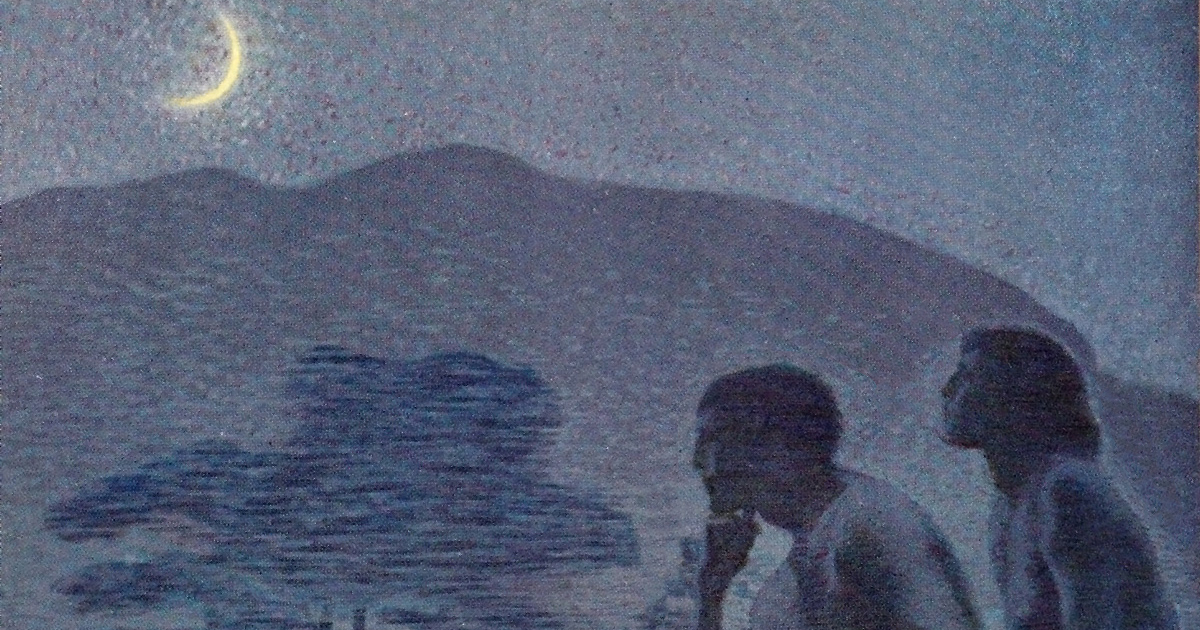
While it is true, as generations of psychologists have found, that “who we are and who we become depends, in part, on whom we love” — a process known as limbic revision — it is also true, as generations of self-aware humans have found, that whom we love depends in large part on who we already are. Our original wounds, our formative attachments, our patterned longings all shape how we engage with those we have chosen to love, to the extent that we are choosing them at all. “People can’t, unhappily, invent their mooring posts, their lovers and their friends, anymore than they can invent their parents,” James Baldwin astutely observed in contemplating the paradox of freedom. “Life gives these and also takes them away and the great difficulty is to say Yes to life.” The great difficulty, too, is how easily those life-expanding Yeses that can open larger vistas of possibility come fear-concealed as Nos, or how those life-preserving Nos that keep us from entering into experiences too damaging or too small for us bear the momentum of pre-conditioned Yeses. And so we project who we are and what we need onto those we love, and find in them reflections of who we long to be or fear we might be, swarming them and swarming ourselves in all the blooming buzzing confusion of our unmet needs. Illustration by Margaret C. Cook for a rare 1913 edition of Walt Whitman’s Leaves of Grass. (Available as a print.) This is not to demean and diminish love as a mere process of projection — Stendhal’s seven-stage delusion of crystallization and decrystallization — or a mere process of reflection — Ortega’s insightful but limited and limiting theory of what our lovers reveal about us — but to honor the elemental fact that each relationship is not between two people, but between three: the two partners, each with their pre-existing patterns of love and loss, and the third presence of the relationship itself — an intersubjective co-creation that becomes the third partner, endowed with the power to deepen those patterns, or to change them. The great peril and great possibility of every love is that this third partner can be a rewounder masquerading as a healer, and equally a healer in disguise, masked beyond recognition by our own patterned way of seeing. So much of our suffering springs from this confusion and so much of our sanity is redeemed when at last we shed our own blinding masks and come to kneel at the fount of clarity. That is what George Saunders explores in his immensely insightful and sensitive annotated reading of Chekhov’s short story “The Darling” — one of the seven classic Russian short stories he examines as “seven fastidiously constructed scale models of the world” in A Swim in a Pond in the Rain: In Which Four Russians Give a Master Class on Writing, Reading, and Life (public library), using each as a portable laboratory for the key to great storytelling. Art by Margaret C. Cook for Leaves of Grass. (Available as a print.) After a beautiful translation of “The Darling” — a story about a woman who loves four very different people the same patterned way, the only way she knows how, which has entirely to do with her learned understanding of love and nothing to do with its objects, and so she suffers greatly when each of these loves leaves her in the same lonely place; a story the essence of which Saunders captures perfectly as being “about a tendency, present in all of us, to misunderstand love as ‘complete absorption in,’ rather than ‘in full communication with'” — he pauses to marvel at Chekhov’s subtlety in challenging our reflex toward lazy binaries, his mastery in training our muscle of ambiguity, uncertainty, and nuance — which is, of course, the only we grasp and savor the full Yes of life. Saunders writes: We see Olenka’s mode of loving, from one angle, as a beautiful thing: in that mode, the self disappears and all that remains is affectionate, altruistic regard for the beloved. From another angle, we see it as a terrible thing, th
The Marginalian · 双语精读
How to Get Love Less Wrong: George Saunders on Breaking the Patterns that Break Our Hearts
2026.07.15 · art
